Challenging Times. Still Building for You...

Yes, times are challenging, and we know many of you are waiting for the products we had planned to release. We want to be transparent and let you know that the recent Native Instruments insolvency has had a significant impact on our business. We have lost all 2025 Q4 sales from the NI Shop, as well as our Alicia’s Keys royalties for Q4.
This naturally affects how fast we can move, even though our ambition remains as strong as ever.
The good news is that development continues. We are actively working on two new bass instruments, five new keyboard libraries, and our upcoming guitar project.
Thank you for your patience, your support, and for staying with us on this journey. It truly means a lot to us.


Merry Christmas & Happy Holidays 2025!
 Merry Christmas and Happy Holidays to everyone. It has certainly been an eventful year. We entered 2025 with a very empty shop after Native Instruments unexpectedly discontinued all products except the Scarbee Rickenbacker Bass. Although we successfully retained the rights to our recordings and programming, we found ourselves in a challenging position as we could no longer use the original product graphics, meaning entirely new interfaces are required for every product we intend to re-release.
At the same time, we were already well underway with the development of our two upcoming bass plugins, built on the new Komplete UI scripting framework. This allows us to deliver larger, sharper 2x GUIs and enables a range of exciting new features. Transitioning from standard Kontakt scripting to Komplete UI has, however, proven more complex than anticipated, and this has naturally caused delays. We also made the strategic decision to develop a dedicated Phrase Player, which is a major undertaking in itself.
Throughout this journey we have been fortunate to have outstanding support. Jimmy Østbygaard has been invaluable with recording and groove creation, and Nils Liberg has shown real brilliance in scripting. Their contributions have been essential, and I am truly grateful.
As the year progressed, we chose to work in parallel on both bass libraries while continuing development on our guitar plugin. The new scripting environment presents fresh challenges here as well, but we are progressing steadily and confidently.
So where are we now, as we reach the end of the year? We are in the final development phase of the bass Phrase Player system, which is shaping up to be something genuinely special. There is still work to do on additional grooves and fills, but the results so far are extremely promising.
With the rapid emergence of AI across the music industry, we made a clear design choice: our Phrase Player will empower you to stay creative. Rather than simply playing back fixed bass lines, it will allow you to craft and shape your own performances, much like Scarbee Funk Guitarist did. We deliver intelligently programmed rhythmic foundations, and you can adapt them to any notes you choose, ensuring the results remain truly your bass lines. On top of that, you’ll have access to a wide range of expressive fills that can be blended in and out, with full control over groove complexity and character.
From a business perspective, our clear objective is to release in Q1 2026. We’re ready to bring something new, meaningful, and inspiring back into the shop.
Thank you sincerely for your patience and continued support. We are deeply committed to delivering products we are proud of, and we’re genuinely excited to share what’s coming next. The next chapter is looking bright.

Set Your Mind Free!

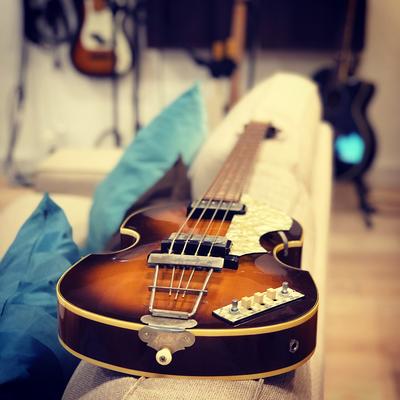
Ever seen Rene Magritte's cheeky painting of a pipe, brazenly captioned "Ceci n'est pas un pipe" (This is not a pipe)? Channel that energy! Our creation may be a digital bass, but it’s not just a bass – it’s a bunch of possibilities in software form! Go rogue and utilize it in ways that’d make a real bass player’s jaw drop if that’s what tickles your track’s fancy.
It’s not just about laying down a groove; it’s about crafting emotions, infusing expressions, and sprinkling a dash of “Whoa, what was that?!” into your mix to get heads bopping and eyebrows arching in delightful curiosity.
Harness the Learning Curve for Virtuosic Results!
Sure, mastering the plugin may chew up a few hours of your time, but remember – becoming a bass virtuoso in the real world demands years.With up to 60 round robin variations on sustained samples (though a tad fewer when you crank up that Muting slider – those vibrating strings are less overtone-happy), we say: go wild! Stick not to one velocity for all notes unless you’re into limiting not just timbral variations but dynamics too.


Peeling Potatoes...
 Imagine trying to cook without ingredients – it’s a no-go, right? That’s content for us in the SCARBEE realm! For the SCARBEE SUN BASS - FINGER, yours truly (Thomas Hansen Skarbye) found himself diving deep into the world of audio bits, recording oodles of them to cook up the instrument of our dreams. In our musical kitchen, we dub this process 'Peeling Potatoes,' and yes, it’s every bit as glamorous as it sounds!
Now, peeling thousands of sonic potatoes (with a dash of complexity and a pinch of huge quantities) meant we needed some specialized tools. Picture us: chopping (cutting), sprinkling a bit of seasoning (tuning), adjusting the flame (volumes), and ensuring each potato (peak) aligns perfectly on the plate, then looping it all into a Michelin-star dish. When it came to the final recordings, I figured, why not tag in a bass player to lay down those last bits? That way, I could keep my sanity intact and channel my full wizardry into the editing and programming!
Cooking Up Bass Magic: The Spicy and Sonic Adventures with MarloweDK
Enter the bass maestro, Thomas Risell (perhaps you know him as MarloweDK, the Groove Master with killer tutorial videos?). Our first culinary adventure together involved recording over 1100 Convolution IR's of various bass cabinets. Then, onto tracking the last articulations, where Thomas bravely battled tuner and volume meters, navigated recording schemes, and nursed his sore fingers through an epic recording day.Having this gig-savvy pro in the studio was not only a blast but also an insight-fest! He tossed some feature wishes into the pot, a few of which were almost too hot for me to handle and sent us on a months-long journey into the realms of delays and, oh boy, the frustrations! Thomas (MarloweDK) got particularly jazzed about the 'Double' stuff... (oh, that excitement was contagious!)
And you know what struck me when I saw him play with a pick during breaks? We needed a muting system that could mimic that style, which turned out to be a complex but fantastic addition to the fingered style too. Implementing this involved digging deep into my advanced programming trick bag.

Time & Phase...
Time & Phase...

SCARBEE SUN BASS – FINGER is our 'bass masterpiece'. It's equipped with advanced programming and scripting that automatically handles a lot of the technical work for you.
My colleague, Nils Liberg, an expert in Kontakt scripting, and myself, Thomas Hansen Skarbye, have dedicated numerous years to developing a comprehensive framework for our bass libraries. Our mission was to tackle and solve some of the most challenging issues encountered with virtual instruments. Users of ex. Classical instrument VSTi's have had to struggle with these issues (like having individual negative track delays for not just to get each articulation arrive in same time - but also to control the timing of different dynamics/velocity) - and Im not sure any other developer has been able to solve these annoying challenges. Our first complicated task was:
-
Automated timing correction of attacks with compensated 'ends' to fill out the 'audio holes':
Our research initially targeted the development of Slap Bass libraries, where techniques like thumbing, plucking, and both upstroke and downstroke with a nail introduce a variety of pre-attack lengths. This groundwork lays the foundation for simplified MIDI programming of these diverse bass lines, including the seamless transition between soft and hard notes.
Without having the various attack peaks consistent - you will have to move the MIDI notes for each articulation manually - making it virtually impossible to change tempo or use groove templates and swing quantization as you will have to re-adjust everything.A hard velocity has a shorter amount of sound before the first peak than a soft velocity because the finger movement speed is different, and different type of articulations can can also have different length of this 'pre-attack' – ex. A thumb attack will have little 'pre-attack' whereas a pluck or a pick-scrape will be very long. So if you cut all the samples so that the first large peak arrive at the same time for all the samples (so you can avoid having different negative track delay for each articulation type), you get the problem that there will be an 'audio-hole' (silence) between 2 succesive notes:
Let’s say you cut the samples so that the first peak is exactly 50 ms from the sample start point.
If you play ex. a soft note with an audible 50 ms pre-attack followed by a hard note with a 5 ms audible pre-attack + 45 ms silence - you will get and audio hole of 45 ms between the notes. The solution is to fill out the holes by delaying the note-off of the first note based on the audible pre-attack length of the second note. However it turned out to be far more complexed than we first thought as you can end up in situations where a NOTE ON begins before the NOTE OFF ends. That took more than a year of experiments and development to come up with a solution that actually worked.
-
Automated phase correction when combining articulations:
When you ex. combine a sustained sample with a whole-note pull-off 'tail' sample (cut at the original recorded transition point), you will only get a smooth, lifelike transition if the phase is 100% correct. If you check this by using a lowpass filter you will hear that the note is 'bending' - like if you used a Pitch-bend on th sustained sample. However if the phase is not correct you will instead hear two notes playing after each other. What we discovered was that even imperfect phase of a single ms would create problems.
First we tried to solve it by introducing advanced EQ envelopes to filter away the 'bumps' at the transitions - but the problem was that while it could fix certain bad transitions - it would at the same time destroy the good transitions. What affected the transition was different 'legato-tail' samples starting on different phase position + the time/length of the previous note. So while we could match a perfect phase in an 1/16 note pull-off in tempo 120 - we would get phase-collision if tempo was 119.9...
Since we also recorded vibrating strings we had to compensate for varying pitch and cycle lengths. And we even compensate for the use of Pitch-wheel and modulations - that also affects the phase.So solution to this was to scan the phase of all samples and then create a system where the Kontakt script knows the exact position of the phase of any sample played - at any time. Then the script automatically moves the second note forward to make a perfect phase. A big challenge was the legato samples as they would consist of 3 parts: the source note, the transition and the target note. All 3 parts would have different phase and we would have to exactly predict the where in the phase cycle our new transition point would appear.
-
automated timing correction of hammer-ons, pull-offs and short slides up/down - after phase is corrected:
As we solved the first phase issue we realised that we would get a timing issue instead as the legato articulations would not be moved forward in same time. Ex the deep notes could have a phase-cycle that was larger than 30 ms and high notes cycles could be less than 1 ms.
And depending on the position of the first notes phase - the legato note could be moved any ms value. Ex if a sustained note (or any legato articulation used as the attack note) with a 30 ms cycle ended halfway - the next note would have to move 15 ms. If cycle ended 1 ms after start - the next note would have to move 29 ms, etc.So we had to come up with a system that would compensate for the disturbed timing - meaning that whenever a legato-sample was moved in time - it would be moved back to correct timing. Now how is that possible? Wouldn’t that mean that phase would be bad again? Yes. But not if we created a timing 'headroom' where we could move the transition imperfect phase...
And this is what we did. We measured the natural timing arrival of ex a 1/16 hammer-on and then created timing compensations for all types of articulations. Ex a semi-tone slide has a shorter transition than a whole-note slide so if both samples are cut at the beginning of the transition - the arrival of the target pitch will be different. And that had to be compensated.So months we were experimenting with time and phase - giving up many times… and then we got obsessed and solved it.

When money walks in - God leaves the room...
Ever since I created my first Scarbee virtual instrument in 1999 they have been artistic experiments - much like an artist who create life-like grass, human bodies or hyper-realistic drawings. I wanted to see how close I could mimic reality and wanted users to experience the magic - and use the magic in their music.
The money and the business has always - and will always just be a mean to make it possible for me to continue creating new stuff - as this is a part of my DNA.
Its not without challenges to have your company based on the mind of an artist - it gets problematic when you partner op with someone who wants to dictate what you can create - or keep on denying you to do things you want to do. I once read a book about the artist Tony Matelli - and some of his emails to the art gallery that made his money was very close to the emails that I have sent to my partners over time. It's the same issues that have bothered Prince, George Michael and many other artists through history.
"When money walks in - God leaves the room..." - people focused on earning money have little understanding of an artistic mind. They do not realise that you need to follow your instinct - even if these different creations function as a "resting" of "purification" period in order to return to previous styles and lift them a level up.
This is how we work. To tell people to "look at the market" and give people what they want - is not how it works. Sometimes you get lucky and get successful with stuff you love - but that's not the same. The point is that its poison to be caged, shelved and instructed to do something just to make money.
I will continue to create stuff that I love - and hope it will be useful for you.
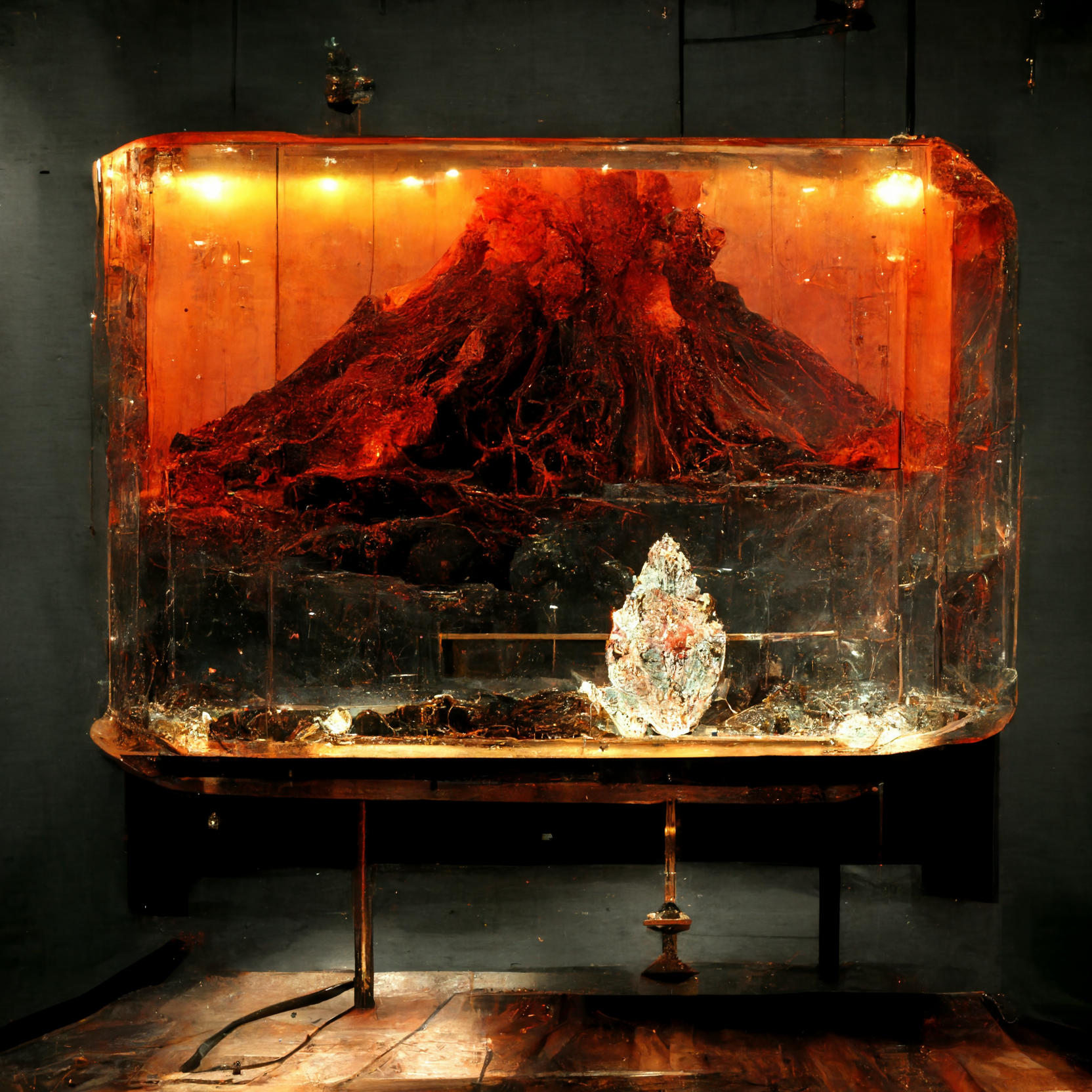
The "Diamond Sculpture and Volcano inside a Diamond" is my creation - using Midjourney AI app.

Art or business?
It wasn't always like that. When SCARBEE started the developers created instrument types - stuff they were expert in. But now traffic are driven to big sale machines and it's getting harder "to be hard".
We hope you will support our company and buy directly from our shop. We will finally release new products in the end of the year - things we have been working on for more than 5 years.
We see ourselves as artists - not business men. So as Miles Davis said: "If you have nothing to say - don't play"...
This is why we have cancelled releases that were not of our standard - hence waiting for something good to be delivered. We will soon play.

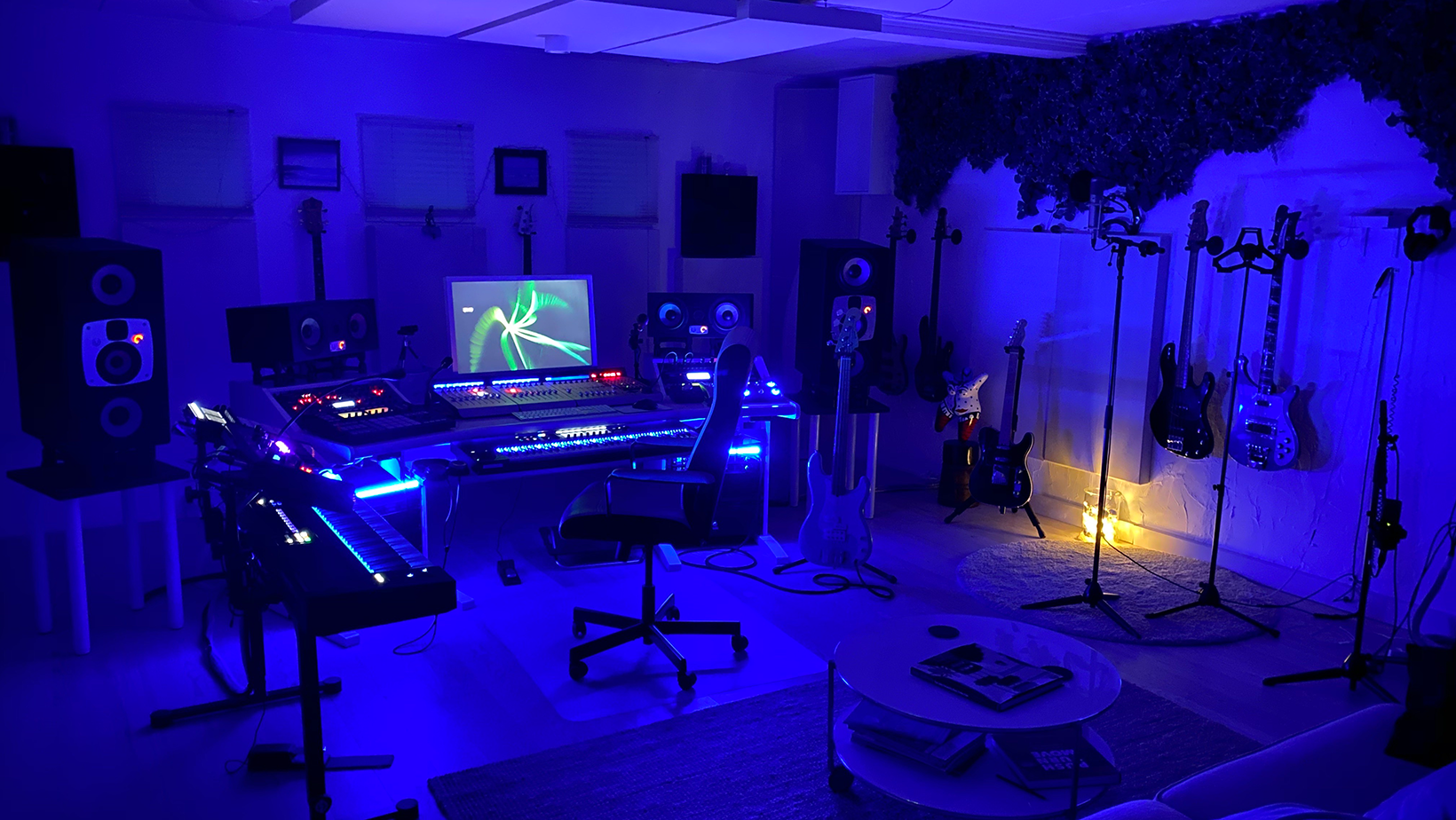
Feeling the blues today?

WAH OF THE WORLDS

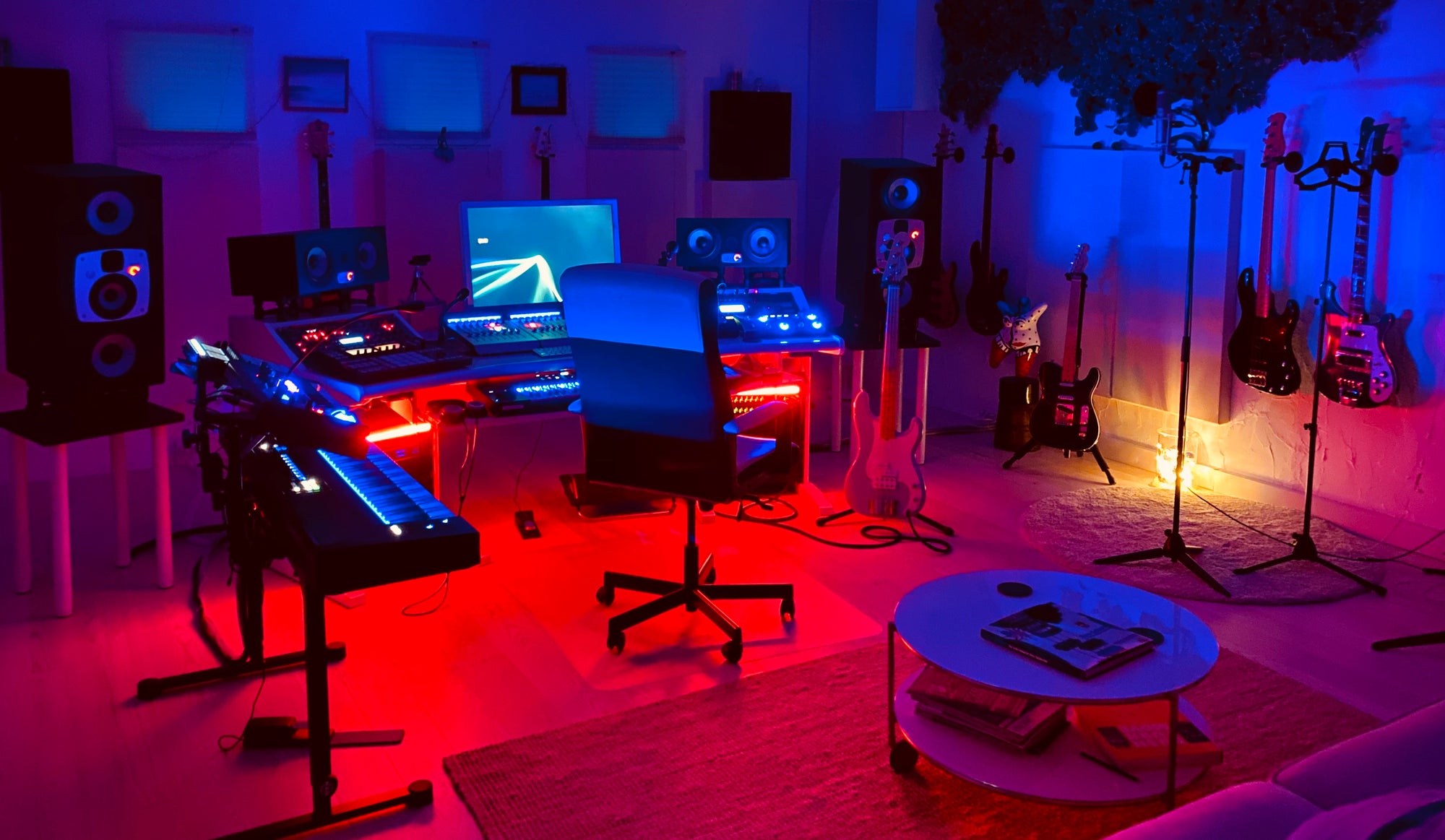
Put on the red light...

Studio setup - nightlife